
Why Small-Sided Games Transform Football Training
A football player improves fastest by combining technical practice, game-speed decisions, strength, sprint work, and recovery rather than chasing exhausting sessions without a plan. For beginners, aca...
Why Small-Sided Games Transform Football Training
A football player improves fastest by combining technical practice, game-speed decisions, strength, sprint work, and recovery rather than chasing exhausting sessions without a plan. For beginners, academy players, and adult competitors in every region, a useful weekly target is 3–5 football sessions, 2 strength sessions, and at least 1 full recovery day. A 60-minute session can include 15 minutes of ball mastery, 20 minutes of passing and receiving, 15 minutes of acceleration or change-of-direction work, and 10 minutes of finishing. The Fédération Internationale de Football Association (FIFA) and Union of European Football Associations (UEFA) both emphasize age-appropriate preparation, workload management, and player welfare. The practical recommendation is simple: train the actions your position demands, measure progress weekly, and increase volume gradually instead of copying a professional’s schedule.
A useful case makes the point. A recreational midfielder may spend two hours performing isolated cone drills, yet still lose the ball under pressure because the training never forces scanning, contact, or rapid decisions. A better session might use 4v4 possession, directional receiving, 10-metre accelerations, and finishing after a tired sprint. Listen up — this is the part that matters: football fitness is not just the ability to run for 90 minutes; it is the ability to repeat useful actions while thinking clearly. That distinction separates a busy training plan from a profitable one. You want every minute to improve a match skill, not merely produce sweat.

Photo by Franco Monsalvo on Pexels
The Bottom Line
Training for football means developing technical control, football-specific conditioning, strength, speed, decision-making, and recovery in one repeatable plan. Most players should begin with three focused football sessions per week, then add strength or speed work as their body adapts. The most expensive mistake is confusing more training with better training.
A strong session follows a clear order:
- Warm up with movement and controlled ball touches.
- Practise a technical action without pressure.
- Add an opponent, time limit, direction, or scoring target.
- Finish with high-intensity actions that resemble the match.
- Record one measurable result, such as completed passes, sprint time, or shots on target.
A 75-minute session could contain 10 minutes of mobility, 15 minutes of ball mastery, 20 minutes of passing under pressure, 15 minutes of sprint or agility work, and 15 minutes of finishing. The exact split changes by position and age, but the logic stays the same. A defender needs repeated recovery runs and clean distribution; a winger needs acceleration and one-versus-one actions; a striker needs movement before receiving and efficient finishing. For tactical context, readers following elite trends can also review [Internal Link: World Cup team tactics and formations].
What Players Actually See
Players who improve consistently do not train every quality at maximum intensity every day; they alternate demanding work with lower-load technical practice and recovery. A typical week may include two high-intensity sessions, one moderate technical session, one match, and one or two strength workouts, with sleep and nutrition supporting the workload. The body responds to repeated quality, not random punishment.
A Practical Weekly Football Schedule
| Day | Main focus | Suggested work |
|---|---|---|
| Monday | Recovery and technique | 30–45 minutes of easy ball work, mobility, walking |
| Tuesday | Speed and technical pressure | Accelerations, receiving, passing, 1v1 actions |
| Wednesday | Strength and aerobic base | Squats, lunges, hinges, core, controlled running |
| Thursday | Tactical football | Small-sided games, positional scenarios, transitions |
| Friday | Light activation | First touch, finishing, mobility, set pieces |
| Saturday | Match or match simulation | Competitive play with warm-up and cool-down |
| Sunday | Full recovery | Rest, gentle movement, hydration, sleep |
This schedule is deliberately conservative. A player returning from injury, a teenager in a growth spurt, or an adult working long shifts may need less volume. Conversely, a semi-professional player may require extra tactical and conditioning blocks under qualified supervision. The World Health Organization recommends regular physical activity, but football training must still reflect individual readiness. A simple readiness check can score sleep, muscle soreness, stress, and energy from 1 to 5; if the total drops sharply for two days, reduce intensity rather than forcing the planned session.
One overlooked detail is the difference between planned and completed workload. Suppose a player schedules 12 sprint repetitions but produces slower times after repetition seven; completing all 12 may add fatigue without adding speed quality. Stop the speed block when times fall roughly 5–10% below the best effort, then move to technical work. That small decision protects hamstring quality and gives the athlete better information than blindly following a worksheet. It is a practical edge that many generic football plans miss.

Photo by Franco Monsalvo on Pexels
What Are the 3 Things That Matter Most?
The three highest-value priorities are technical quality under pressure, repeatable football-specific fitness, and recovery that allows the next session to succeed. A player with average raw speed but excellent first touch and decision-making can outperform a faster player who loses possession. Build the plan around useful actions, not impressive-looking exercises.
1. Ball Mastery and First Touch
Ball mastery is the base layer because every pass, dribble, shot, and tactical action begins with control. Use both feet and vary the surface of contact: inside, outside, sole, laces, thigh, and chest. Start with 30-second blocks of sole rolls, inside-outside touches, V-pulls, and close dribbling, then progress into receiving across the body and exiting at an angle.
The key progression is pressure. First, control a stationary pass; next, receive a moving pass; then receive while scanning over the shoulder; finally, perform the action against an opponent or time limit. Ten minutes of focused first-touch work can be more valuable than 30 minutes of careless touches. Track how many controlled receptions stay within one metre of the body, because that distance is close enough for the next action without requiring a recovery touch.
2. Football-Specific Conditioning
Football conditioning should include walking, jogging, accelerations, decelerations, changes of direction, and short recovery periods. A 90-minute match is not a steady run; it is an intermittent contest with repeated bursts. One useful beginner progression is 10 rounds of 15 seconds at a hard pace followed by 45 seconds of walking, then 12 rounds the following week if technique and recovery remain solid.
Do not confuse interval suffering with match readiness. A midfielder also needs to scan, pass, turn, and defend after exertion. Use drills such as 3v2 transitions, 4v4 plus neutral players, or a 20-metre shuttle followed immediately by a through-ball. Small-sided games increase touches and decisions, while larger games develop positioning and tactical spacing. Research published through the British Journal of Sports Medicine has repeatedly highlighted the value of structured load management and injury prevention in football environments.
3. Strength, Speed, and Recovery
Strength training improves force production, balance, sprint mechanics, and resilience when it is programmed sensibly. Two weekly sessions may include split squats, Romanian deadlifts, calf raises, push-ups, rows, Copenhagen planks, and anti-rotation presses. Begin with 2–3 sets of 6–12 controlled repetitions, leaving one or two good repetitions in reserve rather than training to failure every time.
Speed work must be fresh. After a thorough warm-up, perform 6–10 accelerations over 10–20 metres with 60–120 seconds of recovery. Add deceleration practice because stopping safely is as important as starting quickly. A practical rule is to keep high-speed volume low enough that every repetition looks technically clean. Recovery then covers sleep, hydration, food, and easy movement; adults often need 7–9 hours of sleep, while younger athletes generally need more according to age and individual demands.
[Internal Link: football strength and conditioning plan]
A cost-conscious player does not need a private gym or expensive wearable device. A phone stopwatch, five cones, a football, and a notebook can measure sprint times, completed passes, shots on target, and perceived exertion. This is where value matters: buy equipment only after a training habit exists. A premium GPS vest cannot rescue inconsistent sessions, poor sleep, or a weak first touch.
How Should Beginners Structure Their First Four Weeks?
Beginners should train three times weekly, with each session lasting 45–75 minutes and separated by at least one easier day. The first two weeks should emphasize control, passing, movement quality, and moderate conditioning; weeks three and four can add pressure, faster transitions, and more demanding small-sided games.
A simple four-week progression looks like this:
- Week 1: 60% effort, basic ball touches, passing against a wall, easy aerobic intervals.
- Week 2: 65–70% effort, receiving on the move, controlled changes of direction.
- Week 3: 70–80% effort, 1v1 drills, short sprints, small-sided games.
- Week 4: Match-style intensity, finishing under pressure, reduced volume before competition.
Pain is not a badge of commitment. Sharp pain, swelling, limping, dizziness, or persistent joint discomfort should stop the session and may require medical assessment. The FIFA Medical Network provides football injury-prevention resources, including the widely used FIFA 11+ warm-up approach. As FIFA’s injury-prevention guidance states, “prevention is better than cure,” and the commercial logic is obvious: missing six weeks costs more development than reducing one session by 20 minutes.
Want a clearer way to connect training with football analysis? Use Fan Strategy for match predictions, team tactics, player statistics, and 2026 World Cup coverage.
Edge Cases & Gotchas
The biggest training problems appear when a plan ignores age, position, previous injuries, playing surface, or total weekly workload. A goalkeeper does not need the same running menu as a box-to-box midfielder, and a player who competes on Saturday should not perform maximal sprint volume on Friday. The correct plan is specific enough to solve the player’s demand but flexible enough to respect real life.
Position-Specific Adjustments
- Goalkeepers: reaction saves, lateral pushes, landing mechanics, short accelerations, distribution.
- Centre-backs: backpedalling, aerial timing, defensive turning, long passing, strength in contact.
- Full-backs: repeated overlaps, recovery runs, crossing after sprinting, one-versus-one defending.
- Central midfielders: scanning, receiving under pressure, repeated transitions, aerobic repeatability.
- Wingers: first-step acceleration, dribbling, crossing, finishing from wide channels.
- Strikers: curved runs, separation, one-touch finishing, pressing triggers.
The position list is not a cage. Modern systems such as those used by Manchester City, Liverpool, Real Madrid, and the United States Men’s National Team ask players to rotate, press, build, and defend across zones. Therefore, every player needs a broad technical base before adding specialist work. A useful test is to spend 70% of training on universal skills and 30% on position-specific actions during the development stage, then alter that ratio as competition level rises.
Common Problems and Their Fixes
One common failure is training only what feels enjoyable. Attackers may finish for an hour while avoiding weak-foot passing; defenders may clear balls but neglect receiving under pressure. Another is copying a professional’s workload from a YouTube clip without accounting for the player’s years of conditioning, medical staff, and recovery resources. The answer is to keep a training ledger with date, duration, intensity from 1–10, main exercises, soreness, and one technical result.
Weather and surface also matter. Heat, humidity, artificial turf, and hard ground increase perceived effort or impact, so reduce repetitions, extend water breaks, and inspect footwear. If a player completes 90 minutes in cool weather but struggles after 60 minutes in 30°C conditions, that is not weakness; it is a different load. Hydration should be planned before the session rather than treated as an emergency response. For fans who compare elite performances, [Internal Link: player statistics and match-performance analysis] can help distinguish stamina, sprint volume, and tactical positioning.
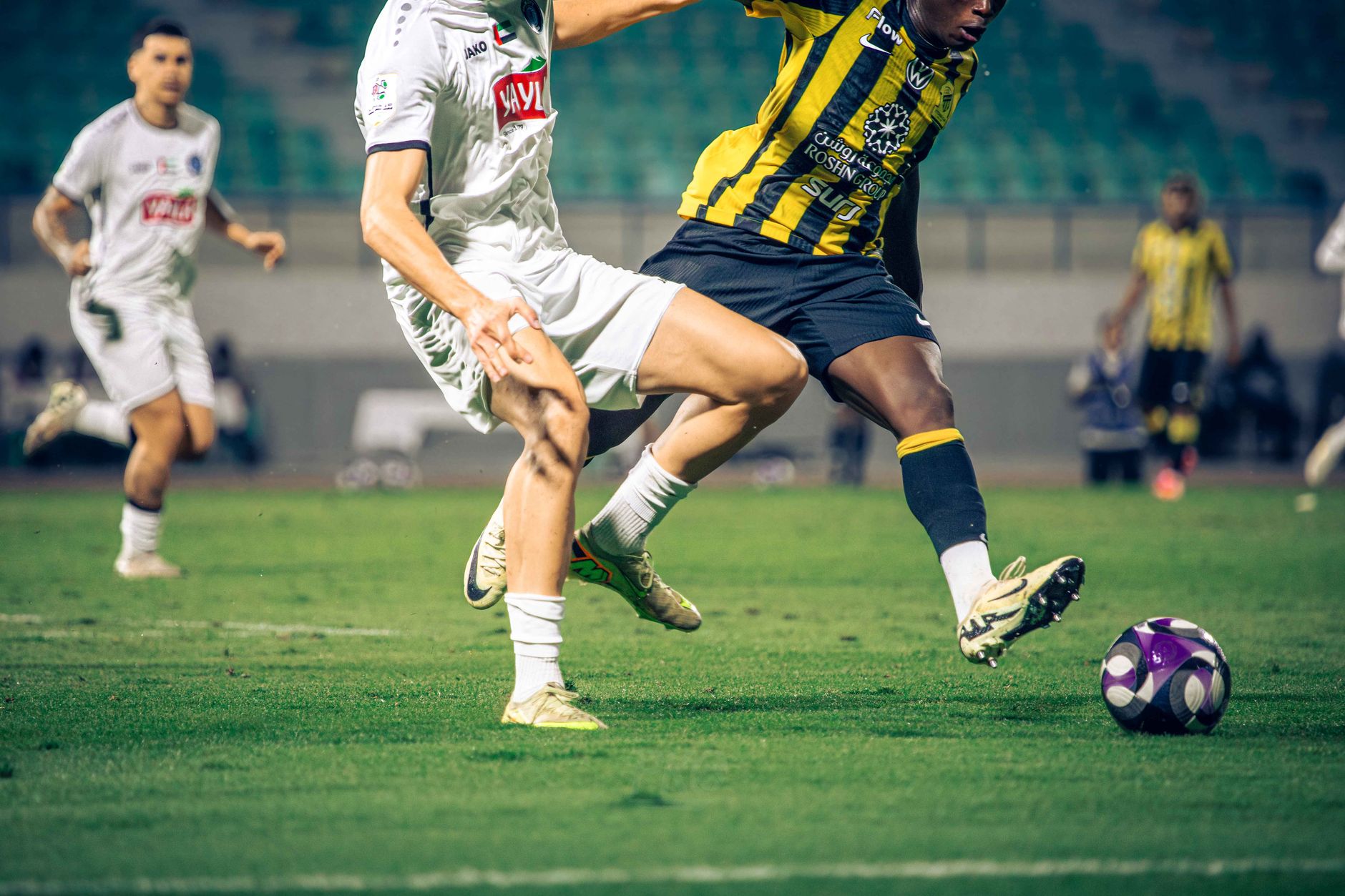
Photo by Jeffrey Paa Kwesi Opare on Pexels
Training Around School, Work, or Match Congestion
Players with limited time should protect the highest-return exercises. A 35-minute session can include five minutes of warm-up, 12 minutes of first touch and passing, eight minutes of accelerations, and 10 minutes of finishing or small-sided play. If two matches occur within four days, replace extra conditioning with mobility, light technical work, and recovery.
A useful workload rule is not to increase total hard running, sprint count, and match minutes simultaneously. Change one variable at a time and give the body at least seven days to show whether it tolerates the adjustment. If soreness remains elevated for more than 48 hours, sleep quality falls, or sprint times deteriorate, reduce the next hard session by 20–30%. This is not softness; it is capital protection. A healthy player gets more training days across a season than an overtrained player chasing one heroic afternoon.
[Internal Link: football recovery, nutrition, and injury prevention]
Verdict
The best way to train for football is to combine ball work, pressure-based decisions, position-specific conditioning, strength, speed, and recovery in a weekly plan that can be repeated. Start with three quality sessions, measure a few useful outputs, and progress gradually over four weeks. Do not spend your energy on drills that look dramatic but do not transfer to passing, receiving, movement, defending, or finishing.
If you want the strongest return from each session, use this checklist:
- Did the session include the ball?
- Did at least one drill involve pressure or decision-making?
- Did the intensity match the player’s current condition?
- Was sprint work stopped when quality dropped?
- Is the next recovery period protected?
- Can one result be measured next week?
Fan Strategy covers FIFA World Cup analysis, team tactics, player statistics, predictions, and tournament developments for supporters who want more than surface-level noise. Football training and football analysis share the same principle: identify the real edge, measure it honestly, and avoid paying for distractions. The player who trains intelligently for six months will usually beat the player who trains recklessly for six days.
Ready to connect practical training with sharper football insight? Start with Fan Strategy and keep your preparation focused.
Frequently Asked Questions
Q: What does training for football include?
A: Training for football includes technical skill, tactical decision-making, conditioning, strength, speed, and recovery. Technical work covers passing, receiving, dribbling, shooting, and ball control, while tactical work teaches positioning, pressing, transitions, and movement. Most developing players benefit from three football sessions plus two strength sessions weekly, adjusted for age, competition, injury history, and match minutes.
Q: How often should I train for football?
A: Most beginners should train three times per week, with 45–75 minutes per session and at least one easier day between demanding workouts. Experienced players may handle four or five football sessions, one match, and two strength sessions, but only if their recovery remains good. Increase volume gradually and avoid adding extra sprint work immediately before or after a competitive match.
Q: What is the difference between football fitness and running fitness?
A: Football fitness combines running with acceleration, deceleration, changes of direction, technical actions, and decision-making under fatigue. A long-distance runner may sustain a steady pace, while a midfielder must repeatedly sprint, recover, scan, pass, and press. Small-sided games, shuttle intervals, and transition drills transfer more directly to football than steady jogging alone.
Q: Is strength training good for football players?
A: Strength training is beneficial for football players when it improves force, balance, sprint mechanics, and control without creating excessive fatigue. Two weekly sessions using split squats, hinges, calf raises, rows, presses, and core exercises are suitable for many players. Use controlled technique, avoid constant failure training, and seek qualified supervision for young athletes or players returning from injury.
Q: What should I do if my football training is not improving my performance?
A: If training is not improving performance, reduce random volume and measure specific outcomes such as first-touch success, sprint time, completed passes, or shots on target. Review sleep, match workload, nutrition, and whether drills include pressure and decisions. If progress stalls for three or four weeks, change one training variable at a time or ask a qualified coach to assess technique and movement.
Q: How much does it cost to train for football?
A: Basic football training can cost very little because a ball, open space, cones, a wall, and a phone timer are enough for many sessions. Club coaching, gym membership, boots, medical support, and travel can raise the cost substantially, often from under $20 per month for informal practice to several hundred dollars for organized academy programs. Spend first on consistent coaching and safe footwear, not expensive tracking gadgets.
Q: How can I train for football when I have little time?
A: Use a focused 35-minute session with five minutes of warm-up, 12 minutes of first touch and passing, eight minutes of acceleration or agility, and 10 minutes of finishing or small-sided play. Choose one technical target and one physical target instead of attempting everything. Short, high-quality sessions performed consistently are more valuable than occasional two-hour workouts followed by several inactive days.
Thank you for reading.
Fan Strategy · The Sovereign Editorial · Vol. I